Which backpack size a child actually needs, in inches rather than birthdays
An age on a label is a guess at a measurement anybody can take in ten seconds. How to measure the back that has to carry the bag, what a litre figure is really telling you, why a laptop diagonal is not a width, and when to buy the next size up.
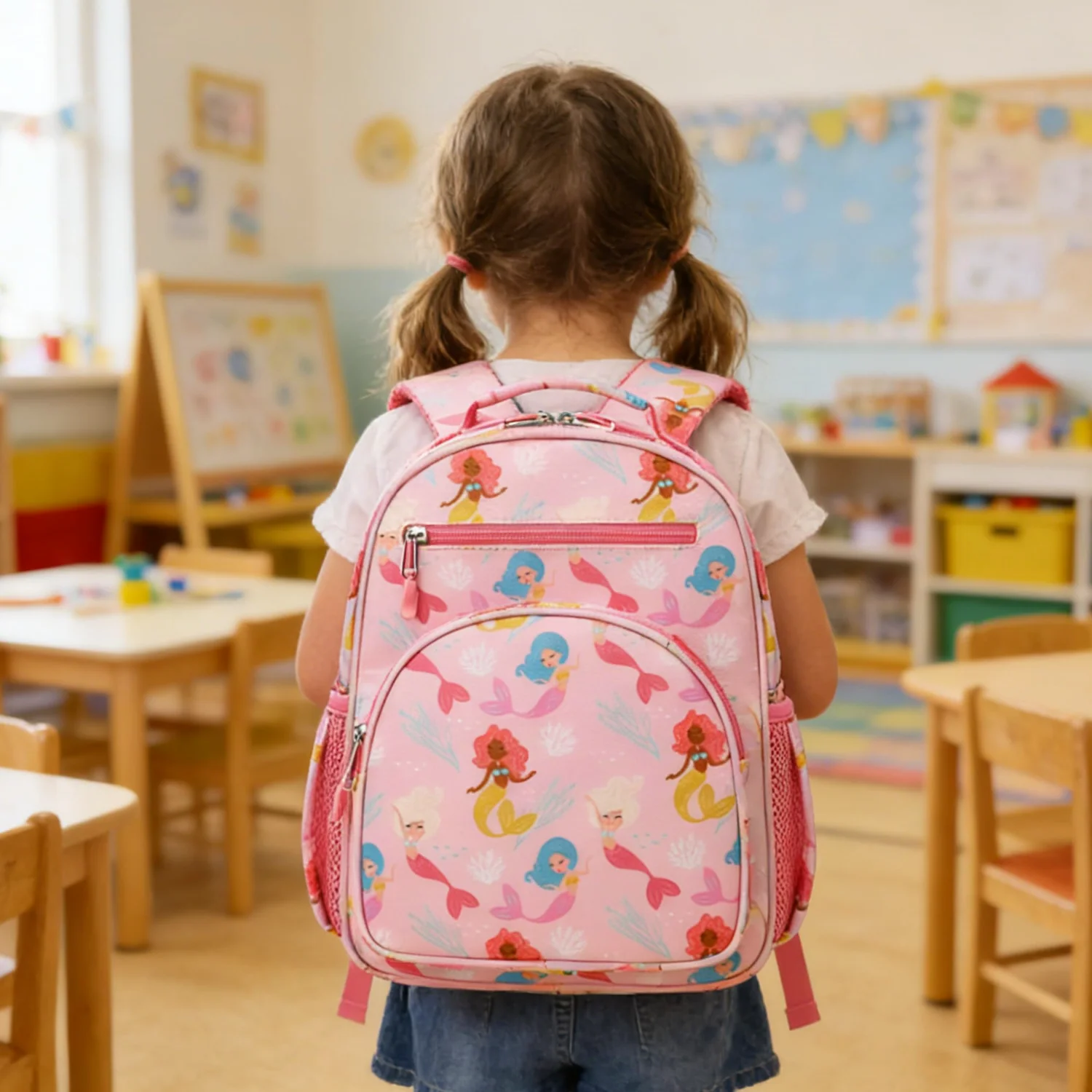
The measurement that replaces the age on the label
An age printed on a school bag is somebody's guess at a measurement, and it is a guess made without meeting your child. The measurement itself takes ten seconds. Find the bony bump at the base of the neck, the one that stands out when the head tips forward, and run a tape from there down the spine to the top of the hip bones. That number is the length of back the bag has to sit on, and it is what the height in inches on every card is answering.
Why the back and not the shoulders, or the height, or the age? Because a backpack fails when it hangs below the bottom. A bag that finishes below the hips pulls backwards on every step, drags the straps outwards off the shoulders, and ends up carried in one hand by the school gate. The same bag two inches shorter sits still. Nothing else about the design compensates for that, and no strap adjustment fixes it. That is the reason the height is the first number on our cards and the age range is nowhere near it.
Children of the same age vary by several inches through the back, and they vary in the other direction too: a tall seven-year-old and a small nine-year-old often want the same bag. If you buy by birthday you will be right about half the time and you will not know which half until October.
Take the measurement once a year, in August, and write it on the inside of a cupboard door with the date. It costs nothing to have and it turns every future bag decision into a two-second comparison.
Four heights, and where each one stops
Our range gives you four rungs to land on, and they were not chosen to look tidy. Each one exists because the one above it was too long for somebody.
The smallest is 11.8 by 9.8 by 4.7 inches. On a two- or three-year-old it reaches from the shoulders to somewhere above the waist and no further, which is the whole design brief for a first bag: a change of clothes, a beaker, a soft toy, and nothing that turns it into a weight. The next step is 14.2 by 10.6 by 5.3 inches, which is the kindergarten size, and the practical difference is that a lunch box now lies flat inside it with a folder beside it.
Then comes 15.5 by 11.8 by 5.3 inches for the elementary years, along with a 13-inch and a 16.5-inch height in the same families, which between them cover the years when a child grows fastest and complains loudest. The bag stops looking like a nursery bag and starts holding two readers and a PE kit.
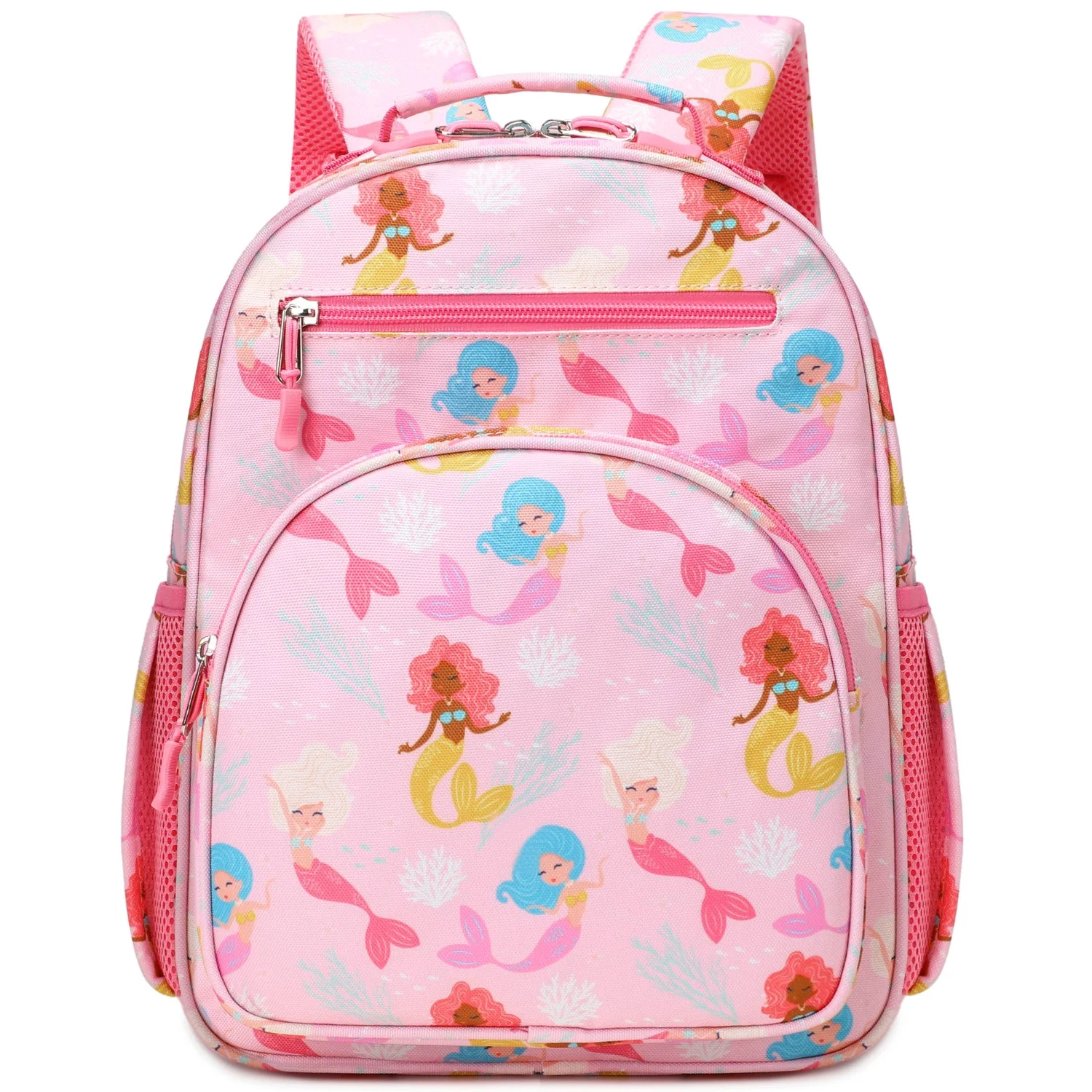
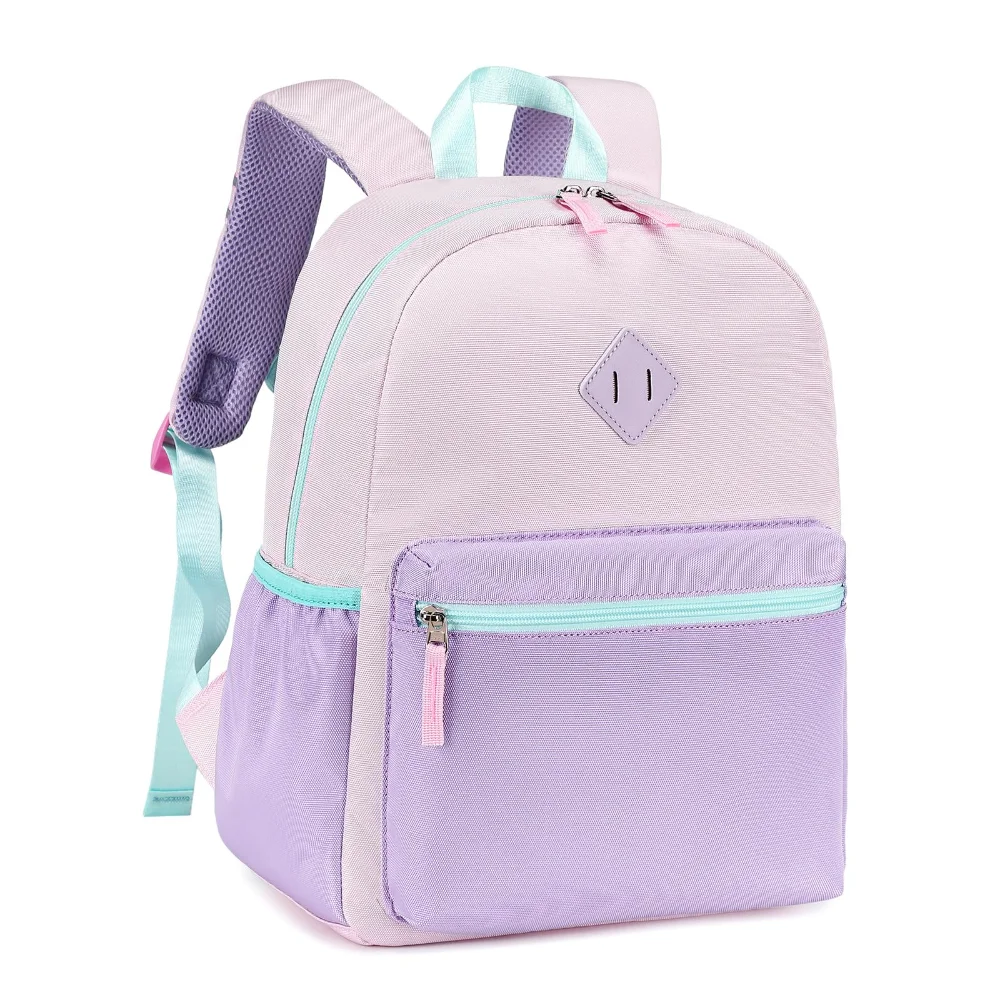
Above that the range changes character. School bookbags arrive at around 17.7 by 11.8 by 6.3 inches with a padded laptop sleeve, and the largest thing we make is 18 by 13.5 by 8 inches. Those two are for a back that has stopped growing quickly and a day that includes a laptop, and putting either of them on a nine-year-old is the commonest way to end up with a bag being dragged along a corridor floor.
What a litre figure is actually counting
A litre figure is the volume of the main compartment plus the pockets, measured the way luggage has always been measured, which is loosely. It counts space, not weight, and the two behave completely differently once a bag is on a back.
The useful thing about litres is comparison between bags of the same shape. Across our range the numbers run 18, 21, 22, 24, 25, 26, 27, 32 and 34. Eighteen is a bag for a laptop and a notebook. Twenty-two to twenty-five is a school day: three textbooks, a binder, a lunch bag and a bottle standing up. Thirty-two and thirty-four are a long weekend with clothes in the bag, and they are more than most people want to walk across a campus with every morning.
The unhelpful thing about litres is that they invite you upwards. A litre of water weighs about a kilogram, which is about 2.2 pounds, so thirty-four litres filled with anything dense is a weight nobody should be carrying to school. The paediatric guidance says it more bluntly: a bigger bag gets filled, and it should be proportional to the child's height rather than to the optimism of the person buying it.
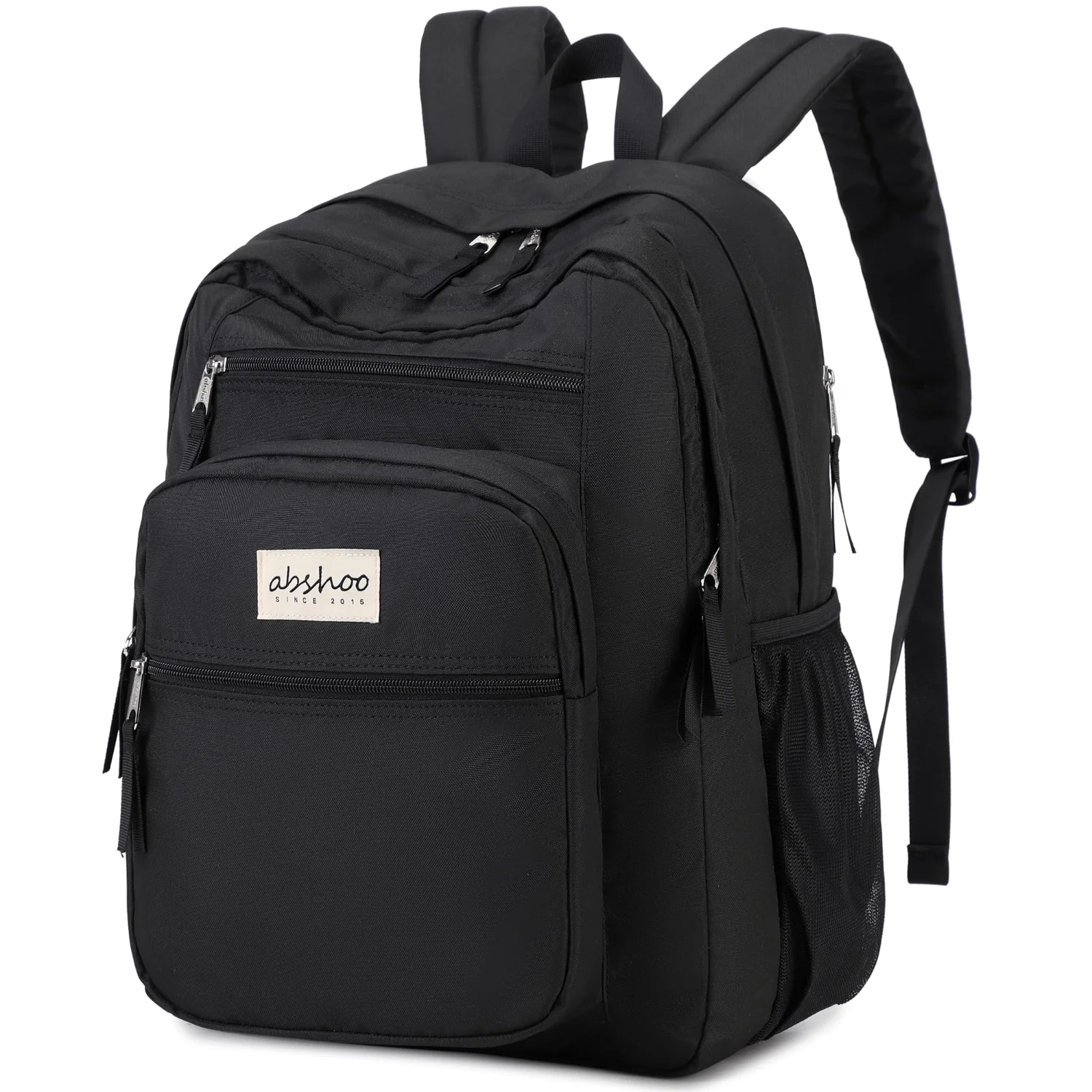
Notice too that half our smaller bags give no litre figure at all. Where the data does not carry one, we leave the line blank rather than estimate it, and the three dimensions do the work instead. On a small bag the dimensions are more informative anyway, because what matters is whether a lunch box lies flat, and that is a question about width and depth rather than about volume.
Inches or litres: which number to trust
If you can only use one number, use the inches. The height decides whether the bag fits the child; the litres decide whether the day fits the bag. Get the first wrong and no amount of capacity helps, because the bag will be carried badly whatever is inside it.
The order to work in is therefore fixed. Measure the back, pick the height nearest below that measurement, and only then look at what the bag holds. If the right height does not hold the day, the answer is usually to take something out of the day rather than to buy the next size up, and the fifteen per cent weight ceiling is the arbiter of that argument.
Measure the back once in August and every bag decision for the next year takes two seconds.
There is one case where the litres come first, and it is the college end of the range. An eighteen-year-old is not growing and the back length has stopped being the constraint, so the question becomes whether the bag is a lecture bag at twenty-two litres or a weekend bag at thirty-four. Even there, the depth is worth a glance: eight inches of depth on the largest bag is a lot of bag to have standing off your spine.
For everybody younger, inches first, every time.
A laptop diagonal is not a width
Sleeve sizes in our range are 15, 15.3, 15.6 and 17 inches, and every one of those numbers is a screen diagonal, measured corner to corner, because that is how laptops are sold. It is not the width of the machine and it is not the width of the pocket.
Two laptops with the same diagonal can be different widths, because the aspect ratio and the bezel differ between models. The number is still the right one to shop by, since it is the number both sides publish, but it means the fit is tighter than the arithmetic suggests. A 15.6-inch sleeve is cut for a 15.6-inch machine and a small allowance, and that allowance is exactly what a hard shell case eats.
So measure the case, not the laptop, if the machine lives in one. A slim neoprene sleeve usually goes in; a rigid shell with rubber corners usually does not, and a laptop that has to be forced into a pocket will wear the seam at the bottom of that pocket within a term.
One more thing about sleeves, since it is easy to over-read them. A sleeve is a lined pocket against the back panel. It stops a pencil case being felt through the machine and it keeps the heaviest object where it belongs, which is low and close to the spine. It is not impact protection, and a bag dropped on a corner puts that shock into the laptop whatever the pocket is made of.
Where a card names no sleeve size, the bag has no sleeve. That is not an omission, and it is worth saying because the preschool and kindergarten packs are sometimes bought for a tablet on the strength of a photograph.
| School stage | Bag height | Roughly | What it is carrying |
|---|---|---|---|
| Nursery and preschool | 11.8 in (11.8 x 9.8 x 4.7) | No litre figure given | A change of clothes, a beaker, a toy |
| Kindergarten | 14.2 in (14.2 x 10.6 x 5.3) | No litre figure given | A lunch box flat, a folder, a bottle |
| Elementary | 15.5 in (15.5 x 11.8 x 5.3) | No litre figure given | Two readers, a lunch bag, a PE kit |
| Middle and high school | 17.7 in (17.7 x 11.8 x 6.3) | 24 to 27 litres | Three textbooks, a binder, a 15.6-inch laptop |
| College and commuting | 18 in (18 x 13.5 x 8) | 18 to 34 litres | A laptop to 17 inches; a weekend at 34 litres |
Sizing up, and what it costs you
Everybody considers it, because a school bag is bought in August and a child grows all year. The arithmetic looks sound: buy one size up, get two years instead of one, spend less overall. It is worth setting out why it usually does not work.
The bag that is one size too big is too big for the whole of the first year, which is the year you paid for. It hangs low, the straps slide, the child hitches it up every hundred yards, and by November it is on one shoulder. Meanwhile the extra volume fills, because that is what volume does, and a bag that is physically too long for a back is now also heavier than the smaller one would have been.
There is a version of this that does work, and it is worth knowing. If the measurement lands between two of our heights, take the larger one, because a bag slightly too long is a smaller problem than a bag that will not close. Between 14.2 and 15.5 inches on a growing five-year-old, 15.5 is a defensible choice. Between 14.2 and 17.7 it is not a choice, it is a gamble.
Our prices make the sums easier than they used to be. The range runs from about thirteen dollars to about fifty, and at the small end a bag that lasts one year and fits properly costs less than the difference between two sizes at the large end. Buying the right size twice is often cheaper than buying the wrong size once.
Where the water bottle lives
This decides more school mornings than any feature on a card, and hardly anybody thinks about it before buying. A bottle inside the main compartment leans against the books, tips over when the bag is set down, and eventually leaks onto homework. A bottle in a side pocket stays upright and stays outside.
Four of our nine kids' backpacks have a side pocket for a bottle, and the card says which. If your child is the kind who knocks a bottle over once a term, that single feature is worth choosing on ahead of the print, and it is the one thing on this list that a child will not thank you for and a parent will.
Check the pocket against your actual bottle, though, rather than against the idea of a bottle. Side pockets on school bags are usually cut for something around 500 millilitres, and a wide insulated flask defeats most of them. It is a common complaint about school bags in general, ours included, and the honest fix is a narrower bottle rather than a bigger bag.
If the bag has no side pocket, the workaround is a bottle that seals properly and lives upright in its own corner, with the books stacked to hold it there. Not elegant, but it is what most of us did.
Two children, one bag handed down
A bag bought for a taller sibling arrives at a smaller one two or three years later, and the question is whether it can be worn rather than whether it is worn out. Measure the second child's back the same way and compare it with the bag's height. If the bag is more than about two inches longer than the back, it is a bag for next year rather than for this one.
Straps complicate the picture in a helpful direction. Every bag in the range has adjustable shoulder straps, and where there is a chest strap it moves up and down as well as tightening across, so a bag can be brought closer to a shorter back than the numbers alone suggest. Five of our nine kids' backpacks have that clip, and on a hand-me-down it earns its place twice.
What does not adjust is the length of the back panel itself. A 17.7-inch bookbag on a seven-year-old is 17.7 inches whatever you do with the webbing, and tightening the straps only lifts it into the shoulder blades where it presses. That is the limit of what a hand-me-down can be made to do, and it is usually the point at which the bag becomes the sports bag instead.
Prints age faster than fabric, which is the other half of the handing-down question. A print survives the years perfectly well and a nine-year-old's opinion of dinosaurs does not, so a plain colour is the better bet for a bag you intend to pass on. Ours come in both, on the same shells, at the same prices.
A checklist you can run standing in the hall
Five things, and none of them takes longer than a minute. Tape from the base of the neck to the top of the hips: that is the height to buy nearest below. Bathroom scale twice, once holding the packed bag and once without, and the difference against fifteen per cent of the child. Bottle into the side pocket, if there is one, to see whether it stands. Laptop, in its case, into the sleeve. Straps tightened until the base of the bag sits at about the waist.
Then the last check, which is the one that catches what the numbers miss. Ask the child to walk away from you and watch from the side. A forward lean from the hips means the load is too heavy, whatever the scale said. A bag swinging below the bottom means the height is wrong, whatever the age label said. Straps sliding outwards mean the chest strap should be done up, or should exist.
If all five come back clean, the bag is right and it will stay right until the child grows, which is usually a year. Put a note in the calendar for next August and get on with something else.
And if one of them fails, the fix is nearly always cheaper than a new bag. Take out the second textbook. Tighten the straps. Move the bottle to the side. Bags get blamed for a great deal that is really about what went into them and how they were worn, and it is worth ruling all of that out before you spend anything at all.
More like this is in School Run, and the makers at abshoo keeps the whole range one click away on the front page.
This is general information about fitting and packing a school bag, not medical advice. Both bodies quoted here describe how a load should be carried; neither claims that a particular bag prevents pain or injury, and neither does this page.