Clear bag rules, read properly before you buy one
The stadium rule is twelve by six by twelve, and the sentence that turns bags away at the gate is the one after it. What the published policy actually says, why a school district rule is a different animal, and how to tell a bag that will pass from one that will not.
The rule is one paragraph long
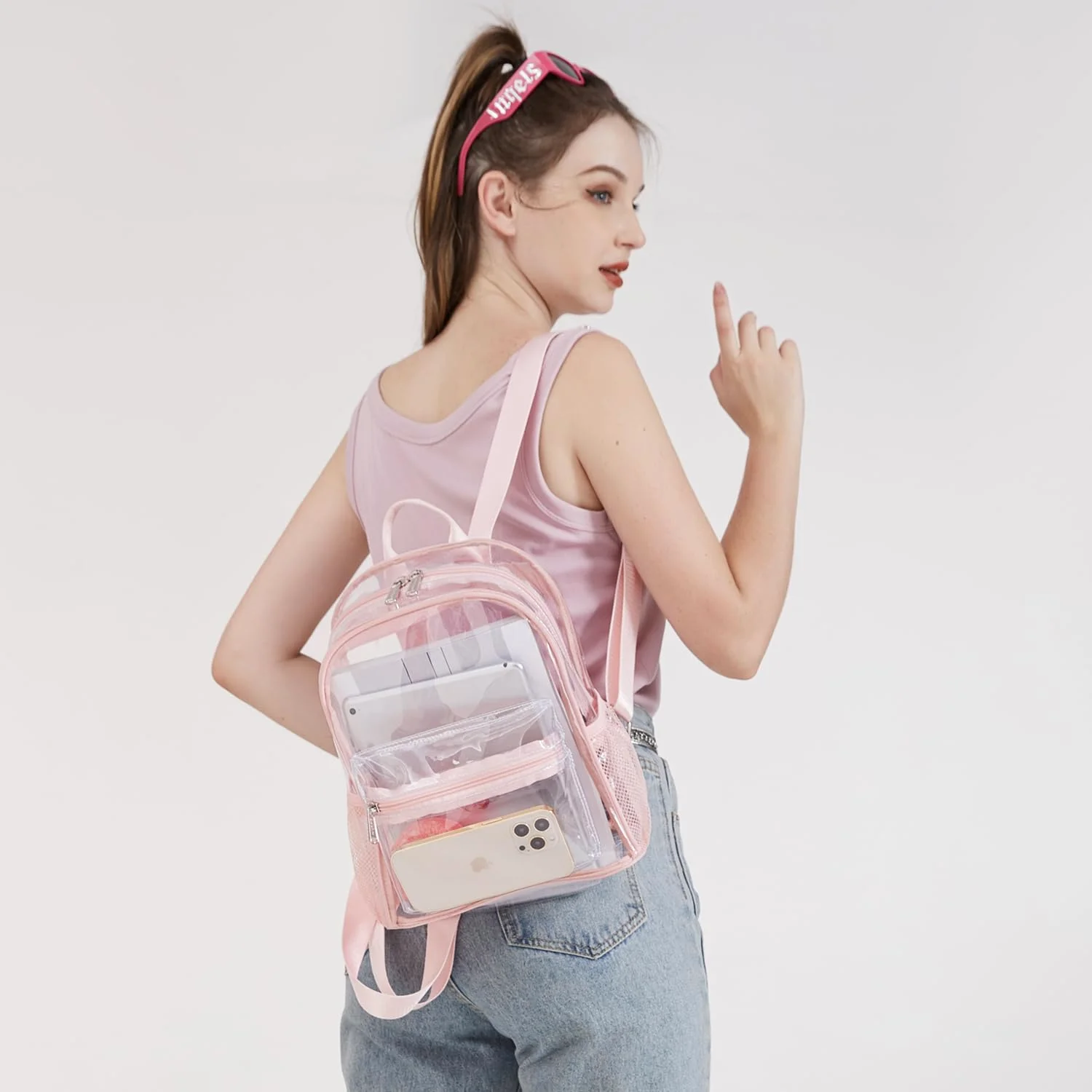
Most of what people believe about clear bags comes from somebody at a gate the year before last. The actual policy is short enough to read on a phone in the queue, and reading it once will save you the price of a bag. It says that a bag may be brought in if it is clear plastic, vinyl or PVC and does not exceed 12 by 6 by 12 inches, and it names the shapes that counts for: clear backpacks, clear fanny packs, clear cinch bags. Nothing about the material has to be guessed. Nothing about the shape has to be guessed either.
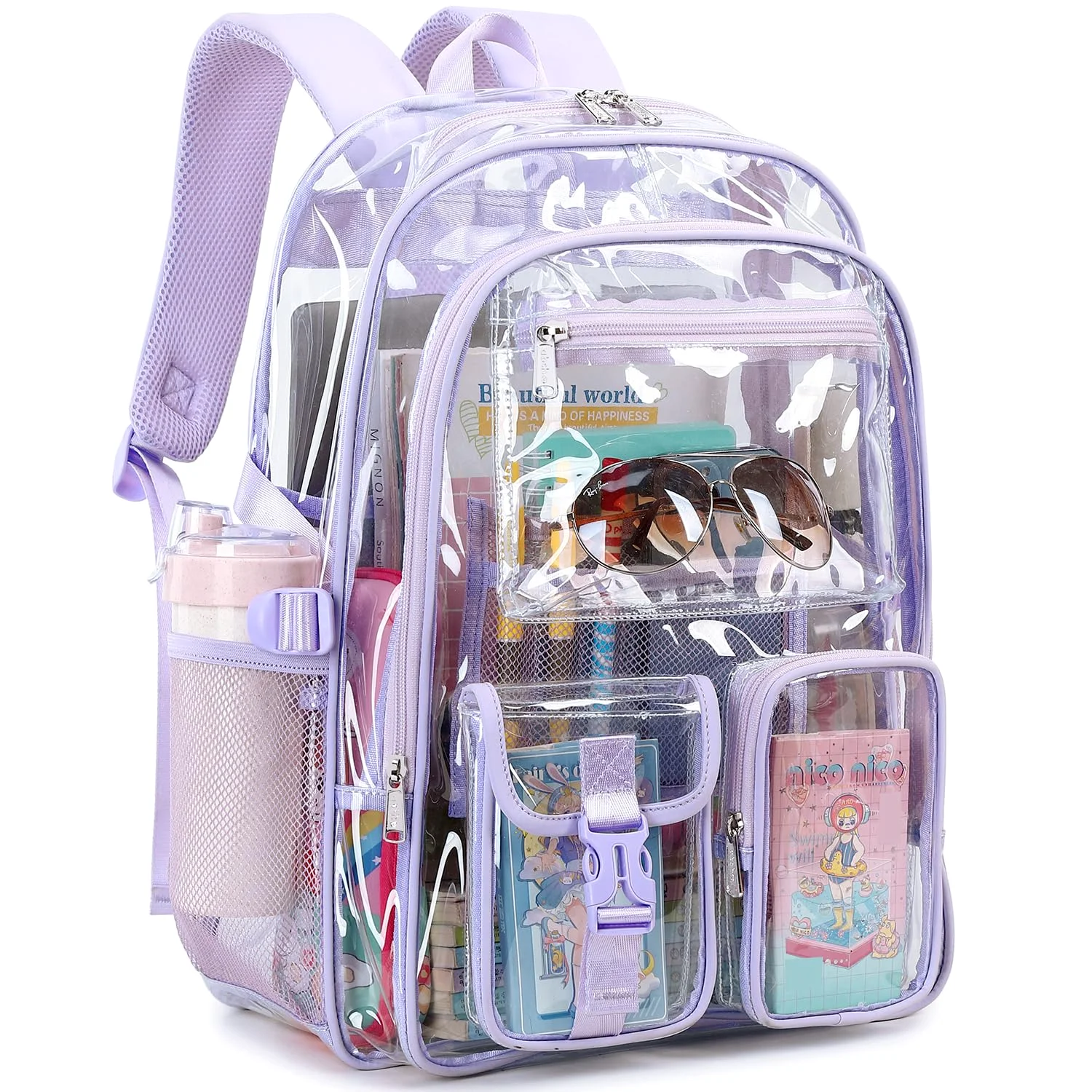
Alongside that bag you are allowed one small non-clear bag no larger than 4.5 by 6.5 inches, with or without a handle or strap, and a one-gallon clear freezer bag if you would rather carry that. Those three things together are the whole of what the policy permits, and the list of what it refuses is longer: coolers, briefcases, non-clear backpacks, non-clear fanny packs, diaper bags, non-clear cinch bags, luggage of any kind, computer bags, camera and binocular bags. Medically necessary items are the standing exception, after inspection.
The last line of the policy is the one that matters most and gets quoted least. It tells you to check the individual team's website for the guidelines specific to that stadium. A venue is allowed to be stricter than the league it plays in, and some are. So the rule below is the floor, not the ceiling, and the page you need is the one belonging to the place you are going.
None of this is complicated. What makes it feel complicated is that the number gets repeated without the sentences around it, and the sentences around it are where the refusals come from.
Twelve by six by twelve, standing up
Write the dimensions down in the order the policy gives them and then turn them the way a backpack stands. Twelve inches wide, six inches deep, twelve inches tall. A clear backpack that measures 12 by 12 by 6 inches is the same box described from a different starting corner, and two of the nine clear bags we make are cut to exactly that: the stadium mini backpack and the clear stadium crossbody.
Depth is where people come unstuck. Twelve by twelve sounds roomy and it is, until you notice that six inches is not much once a bag has a padded back panel, a front pocket and something bulky inside it. A bag can measure correctly empty and bulge past six inches with a jumper in it, and a gate that is measuring rather than glancing will see that. Pack it flat.
The other thing worth knowing before you buy is what six inches of depth holds. A phone, a wallet, keys, a small camera, a rolled-up rain shell if it is a light one. Not a hoodie, not a laptop, not a picnic. Our stadium bags are fixture bags rather than day bags, and they cost between about thirteen and twenty-two dollars precisely because they are not trying to be anything larger.
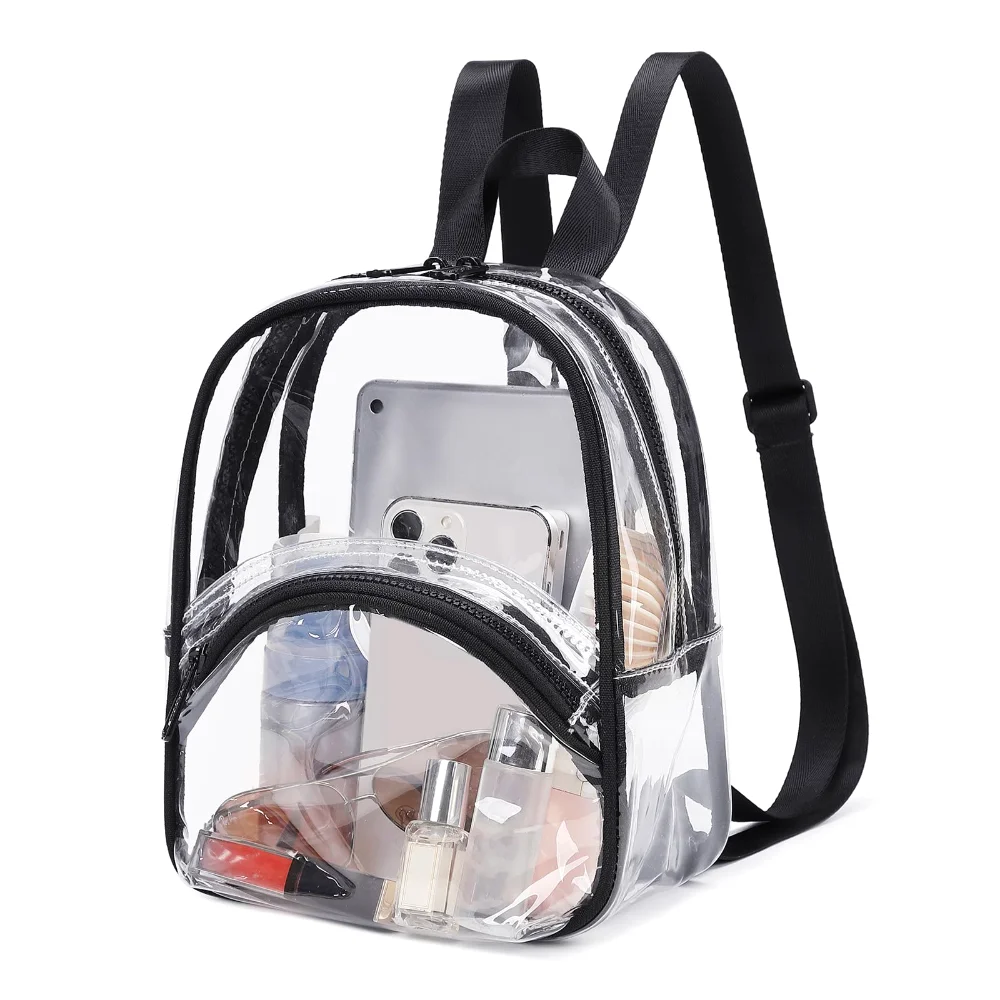
The rest of our clear range is over the limit on purpose. The 16.5 and 17.7-inch clear school bags, 22 and 25 litres, one of them with a padded sleeve for a 15.6-inch laptop, are bought for a school corridor rather than a turnstile, and they will not pass a stadium gate. That is not a design failure. It is two different rules being answered by two different bags, and the card says which is which.
The sentence that turns bags away
Size gets the attention; hardware gets the refusals. The policy says that no buckles, grommets, hardware or decor may conceal any part of the bag, and it says a logo may appear on one side of the bag only. Read that as security reads it: they need an uninterrupted view into every compartment from outside, and anything opaque enough to hide a hand-sized object is a problem regardless of how the bag measures.
In practice that rules out a whole category of bags sold as stadium bags. A broad glitter trim around every panel. An opaque base, which is common because it is cheap and it hides the wear. A decorative front pocket in solid fabric. A quilted flap. Each of those can sit on a bag that is exactly 12 by 6 by 12 inches and each of them can still get the bag turned round at the gate, and by then you are in a queue with a bag you cannot leave anywhere.
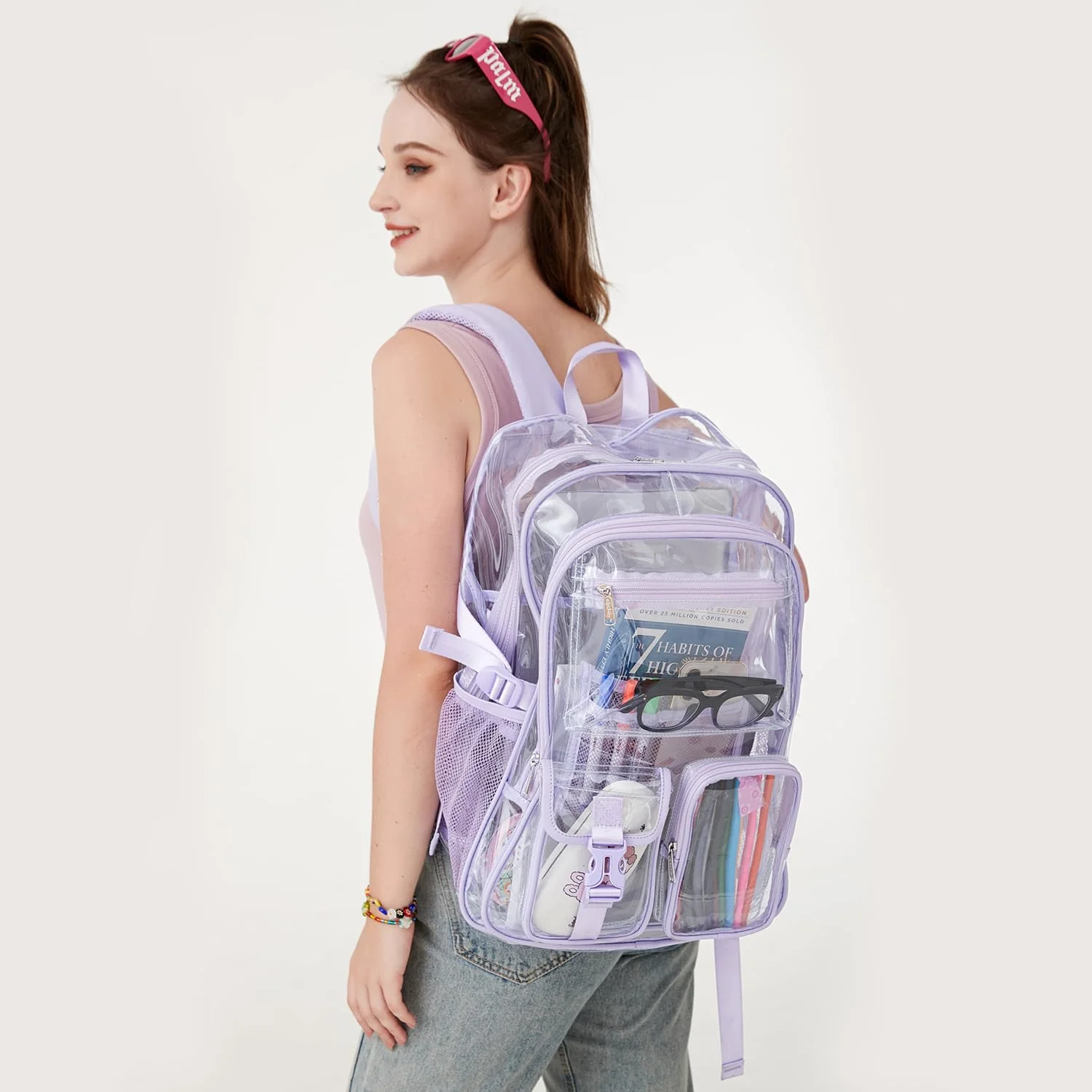
A bag can measure correctly on a table and still be turned round at the turnstile, because opacity is the other half of the rule.
Bound edges and straps are a different matter. A clear panel has to be finished at the edge or it splits, and every clear bag we make is bound in fabric webbing for exactly that reason. Webbing along a seam does not conceal a compartment; it frames one. So does a strap, and so does a zip. What a gate objects to is opacity across a face, not the trim that holds the faces together.
The honest position for a maker to take is this: we can cut a bag to the published box and keep the opaque parts to the edges and the straps, and that is all we can do. We cannot promise you a gate. A steward with a bag policy printed that morning has the last word, and the only way to improve your odds is to check the venue's own page before you order rather than after.
What you are allowed to carry alongside it
The small non-clear bag is the part of the policy that gets forgotten, and it is the part that makes the whole arrangement bearable. Up to 4.5 by 6.5 inches, clear or not, with a strap or without. That is a phone, a card, a set of keys and a lipstick, carried in something you do not have to be seen into.
Take that allowance seriously when you are packing, because it changes what the clear bag is for. Anything you would rather not display goes in the small bag. Anything bulky goes in the clear one, where security can see it in two seconds and wave you through. People who queue happily have usually worked this out; people who queue unhappily are the ones with everything jumbled into a transparent box.
The one-gallon freezer bag is the other permitted option and it is worth knowing about even if you never use it. It costs nothing, it folds into a pocket, and for a person who owns no clear bag at all it turns a refusal into an inconvenience. It is not comfortable to carry and it does not have a strap, which is the whole argument for owning a proper one.
What you cannot do is bring two clear bags, or a clear bag and a computer bag, or a clear bag inside a tote. The list of prohibited items reads long but it collapses to a simple idea: one clear bag, one small bag, and nothing else with a lid on it.
A school gate is not a stadium gate
A district that asks for clear bags is not working from the league policy, and assuming otherwise is the commonest mistake parents make in August. School rules are written locally, they are usually about a full school day rather than a three-hour fixture, and they almost never specify 12 by 6 by 12 inches, because a bag that size does not hold a school day.
What a district usually asks for is that the bag be see-through and that the contents be visible without opening it. Some name a maximum size, some name a material, some simply say clear. A few permit mesh. Almost all of them are published as a PDF on the district site, and the ten minutes it takes to find it is the best-spent ten minutes of the whole shopping trip.
That is why the larger bags on our clear shelf exist, and why they are shaped like school bags rather than like pouches. A 17.7-inch clear backpack at 25 litres takes a folder, three textbooks, a lunch bag and a laptop in a padded sleeve, and it does all of that while being visible from outside. A stadium-legal bag does none of it. Buying the stadium size for a school year is the mistake that gets returned most often, and it is entirely avoidable.
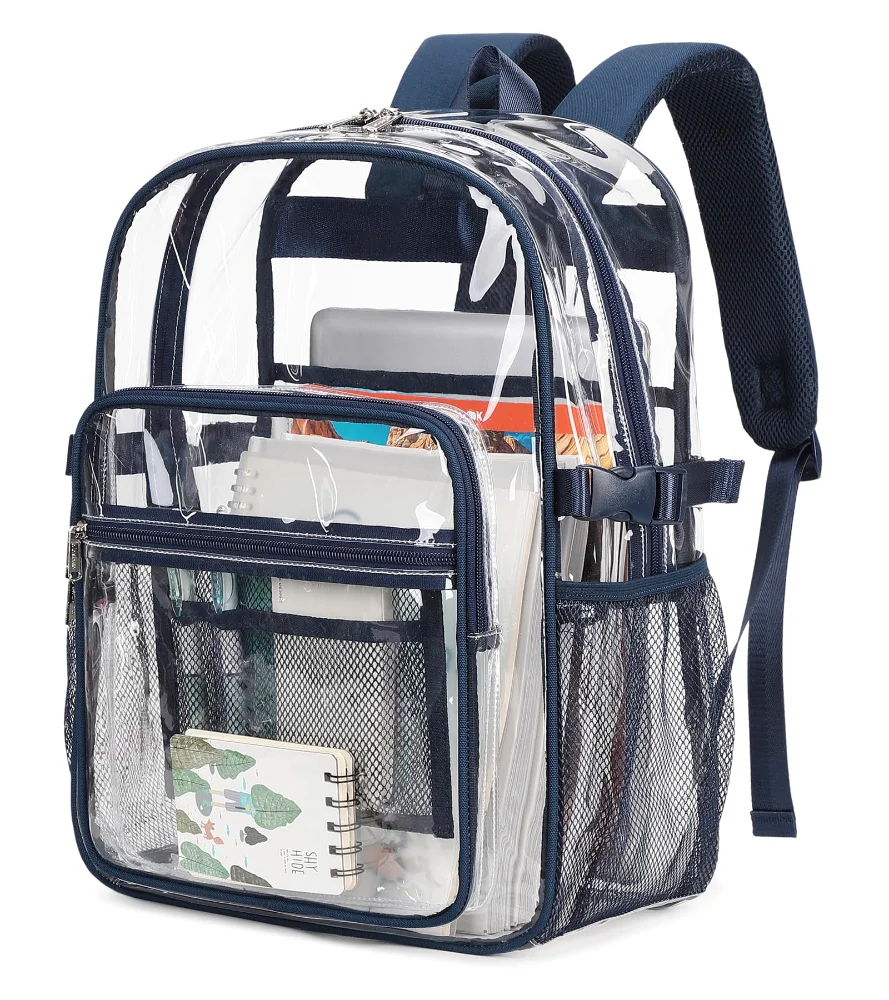
The reverse mistake costs more. A clear school backpack bought for a Saturday fixture will not go through the turnstile, whatever it cost and however clear it is, because it is over the box in every dimension. Two rules, two bags, and the only household that needs both is one where somebody goes to matches.
| What is being asked | The published stadium rule | What a school district usually wants | What we make for it |
|---|---|---|---|
| Maximum size | 12 by 6 by 12 inches | Rarely specified; a full school day has to fit | 12 by 12 by 6 in, or 16.5 and 17.7 inches |
| Material | Clear plastic, vinyl or PVC | Clear, sometimes mesh accepted | Heavy-gauge PVC, edges bound in webbing |
| Decoration | No hardware or decor concealing any part | Usually silent | Trim kept to bound edges and straps |
| A second bag | One non-clear bag up to 4.5 by 6.5 in | Usually silent | Not sold; any small pouch does |
| Where the rule lives | The league page, plus the venue's own | The district's own policy document | On the card: dimensions and litres |
Mesh, and the day it is enough
Mesh is the forgotten answer, and for a school year it is often the better one. A mesh bookbag is not transparent, but it can be seen into, and a school that wants a glance rather than a forensic view will usually accept one. Ours is 25 litres in three colourways, and it carries far more comfortably than PVC because it is cloth: it moves with the back, it does not stiffen, and it does not squeak.
Where mesh loses is precision. A district that has written the word "clear" into a policy means clear, and a steward reading that policy is not going to make a judgement call about weave density on your behalf. If the rule says clear, buy clear. If the rule says the contents must be visible, mesh is worth asking about before you spend anything.
Mesh also behaves differently with small objects. A pencil sharpener seen through mesh is a shape rather than an object, which is fine for a school corridor and useless at a security check. That is the real dividing line between the two materials, and it explains why stadiums never accept mesh while plenty of schools do.
There is one practical advantage nobody mentions. Mesh dries. A PVC bag that gets rained on holds water in the seams and needs turning upside down on a radiator; a mesh bag is dry in twenty minutes. For a child who walks to school in a wet climate, that is not a small thing.
What heavy-gauge PVC does in the cold
Clear bags fail in a specific way and it is worth knowing about before January. PVC stiffens as the temperature drops, and it is at its most brittle at a fold or a crease. A panel that has been creased and left creased is a panel with a line of weakness down it, and cold weather is when that line turns into a split.
Which means storage matters more than use. A clear bag stored flat in a warm cupboard will come through a winter without complaint. The same bag folded into a car boot in December, taken out stiff and opened sharply, can craze along the fold, and once a PVC panel has crazed the mark is permanent. Nothing about the grade of the material changes that; it is what the material is.
The edges are the other vulnerable place, and this is where a bag either has been made properly or has not. Two clear panels welded directly to each other split at the weld. Two panels bound with fabric webbing have something flexible taking the stress, and that is why every clear bag we make is bound at every edge rather than heat-sealed. It costs more to sew and it is the difference between one season and several.
Warm it before you fold it. On a cold morning, give a clear bag five minutes indoors before you stuff it into anything, and it will fold like a bag rather than like a sheet of ice.
The phthalate question, answered honestly
Search for clear backpacks and you will find bags advertised as phthalate-free as though it were a certification. Here is what the federal rule covers, because the difference matters. The cap on eight named phthalates at 0.1 per cent applies to a children's toy, meaning a product intended for a child of twelve or under for use when the child plays, and to a child care article, meaning a product made to help a child of three or under sleep, feed, suck or teethe.
A backpack is neither of those. It is not a toy, a child does not play with it, and it has nothing to do with sleeping or feeding. So the rule does not reach it, and a bag that wears the number as a badge is borrowing a limit written for something else. We would rather say that plainly than let a customer believe a legal test has been passed that was never applied.
What this does not mean is that the question is silly. Soft PVC is plasticised, plasticisers migrate, and a parent who would rather not have a plasticised sheet in a child's hands every day is making a reasonable choice. The honest answer to that is a fabric bag, or the mesh bookbag, rather than a clear bag with a reassuring sticker on it.
Where we do have something to say, we say it on the card: the material, the dimensions, the litres. Where the rule belongs to somebody else, we link to the page that sets it and leave the interpretation to the people who wrote it.
Five minutes with a tape measure before the fixture
Do this the evening before rather than in the car park. Take a tape to the bag you already own and measure it packed, not empty, in all three directions. Twelve, six, twelve. If any of them is over, the bag is over, and the fact that it was fine last season means only that somebody was in a hurry last season.
Then look at it the way a steward will. Stand at arm's length and ask whether you can see into every compartment without opening anything. A trim wider than a thumb, an opaque base, a solid front pocket: each of those is a conversation you do not want to be having at a turnstile. Turn the bag over and check the back too, because a padded back panel in solid fabric is the one people miss.
Open the venue's own bag policy page while you are at it. Search the venue name and the words bag policy, and read the whole page rather than the headline. Arenas and college grounds often have their own additions, and a policy dated this season is worth more than a memory from last one.
Finally, pack the small bag. Phone, card, keys, and whatever you would rather not have on display, in something no larger than 4.5 by 6.5 inches. Then the clear bag holds the things nobody minds seeing, the queue takes fifteen seconds, and the rule stops being an annoyance and becomes what it was written to be, which is a faster way in.
More like this is in School Run, and the abshoo bench keeps the whole range one click away on the front page.
Bag rules are set by the venue and they change. Everything here quotes a published policy with the date it was read, and an individual stadium, arena or school district is allowed to be stricter than the policy it works from. The rule that counts is the one on that venue’s own site on the day you go.